The Analytics Terminal for
Bitcoin Treasury Companies
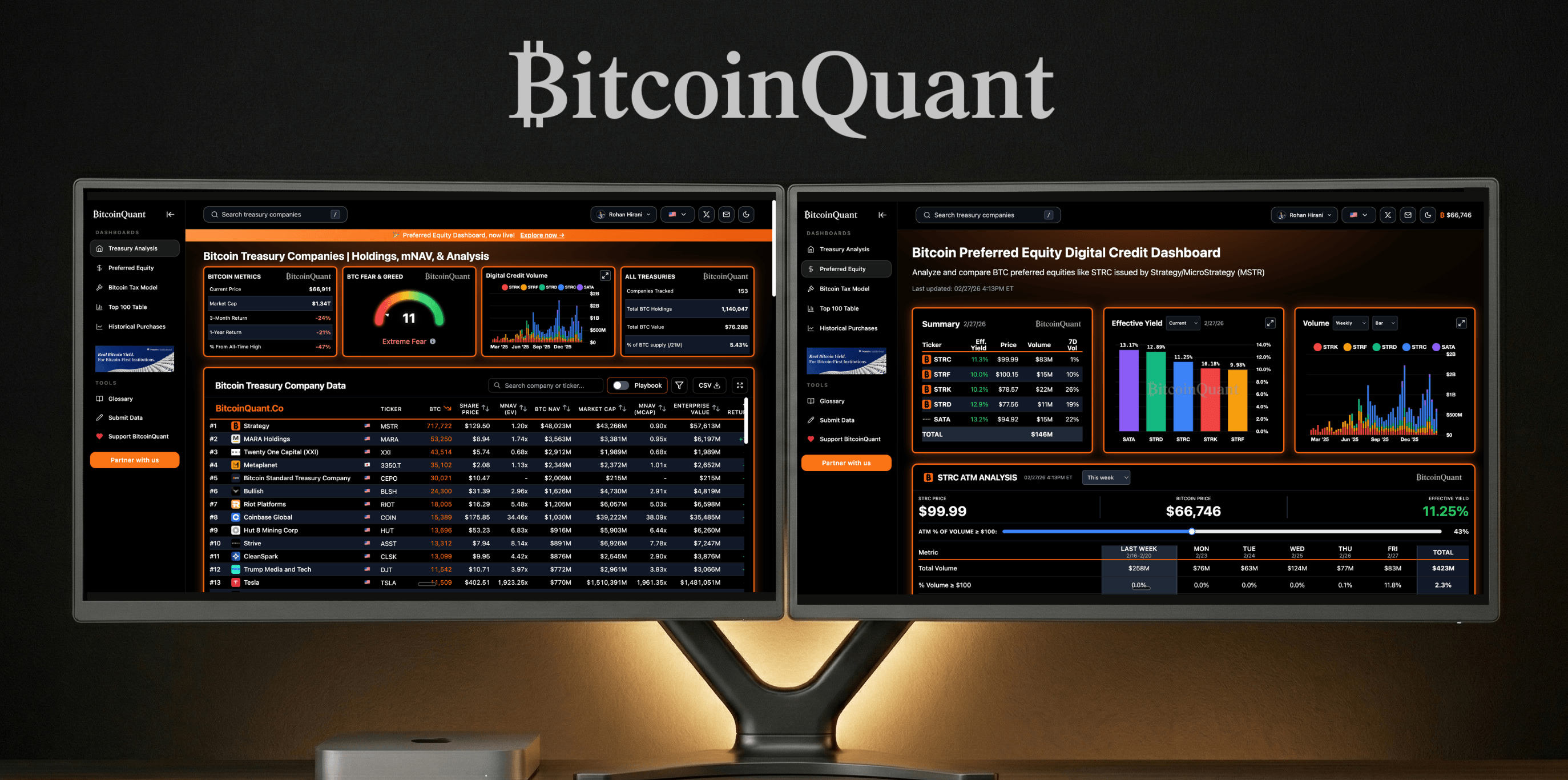
BitcoinQuant tracks BTC holdings, mNAV, stock returns, volume, volatility, and digital credit preferred equities across Strategy (MSTR) and 100+ Bitcoin treasury companies.
As seen on






Who BitcoinQuant is built for
Professional investors
Sort 100+ Bitcoin treasury stocks by mNAV, returns, volatility, or 30+ columns. Spot who’s accumulating and where the premium is mispriced.
Corporate finance teams
Benchmark your BTC treasury strategy against peers with enterprise value breakdowns, preferred equity comparisons, and capital stack analytics.
Researchers & journalists
Access BTC holdings, share counts, and analytics for 100+ treasury companies. Export any view to CSV for models and research.

Track every Strategy & Strive preferred stock.
Strategy's/MSTR's preferred equity suite — STRC, STRF, STRK, STRD — and Strive's/ASST's SATA represent a new asset class: Digital Credit backed by corporate Bitcoin treasuries. BitcoinQuant is the primary dashboard that tracks price, effective yield, volume, volatility, and notional value across all five instruments side by side.
- Real-time price and effective yield for STRC, STRF, STRK, STRD, and SATA
- Historical charts for price, volume, and volatility with daily granularity
- Notional value and market cap tracking across the full preferred equity stack
Predict Strategy (MSTR) weekly Bitcoin purchases before the 8-K.
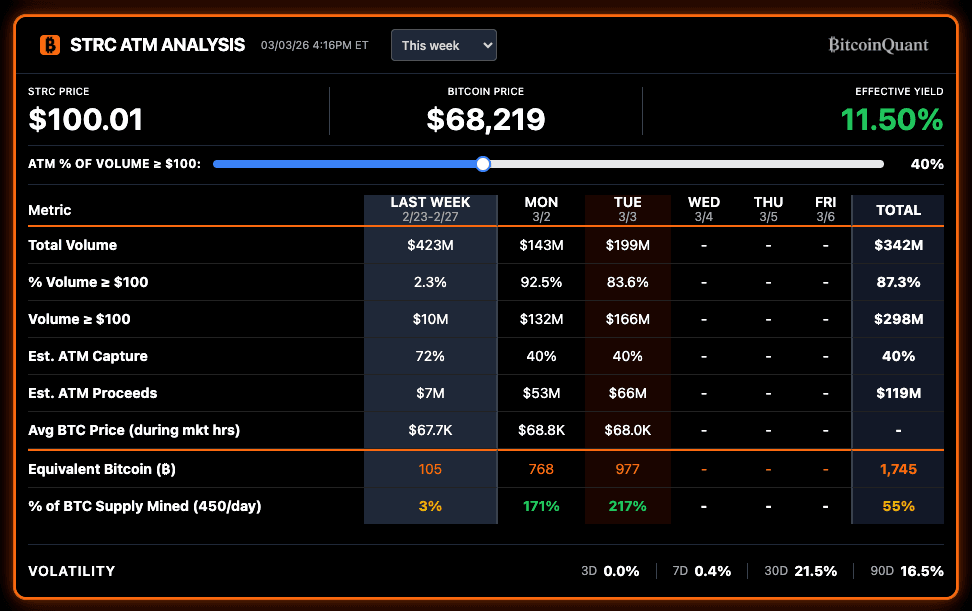
BitcoinQuant's STRC ATM Analysis tracks real-time intraday trading volume above $100 par to estimate how much Bitcoin Strategy is acquiring through its STRC ATM offering each day. By analyzing minute-level volume, VWAP thresholds, and live BTC prices, the tool calculates estimated ATM proceeds and equivalent BTC purchased — giving you a forward look at the numbers Strategy / MicroStrategy (MSTR) reports in its weekly 8-K filings every Monday.
- Minute-level STRC volume analysis with real-time $100 par threshold tracking
- Daily and weekly ATM proceeds estimation with adjustable capture rate
- Equivalent Bitcoin calculation using live intraday BTC prices
- Weekly totals you can compare to Strategy's/MicroStrategy Monday 8-K filing announcements
Coverage
Every metric that matters.
BTC Holdings & Accumulation
Total Bitcoin held, daily acquisition rates, and each company's % of the 21M BTC supply.
mNAV & Enterprise Value
mNAV (EV / BTC NAV): know instantly if a treasury stock is overvalued relative to its Bitcoin.
Digital Credit & Preferred Equity
Real-time yield, price, volume, and market cap for STRC, STRF, STRK, STRD, and SATA.
Stock Returns, Vol & Options
Native-currency returns, volatility, trading volume, open interest, and BTC correlation.
Debt & Credit Analysis
Debt-to-BTC NAV, BTC credit ratings, cash coverage ratios, and enterprise value breakdowns.
Global Coverage
20+ countries. Automatic FX conversion. Native-currency returns. Japan to Israel to Sweden.
Dashboards
Tools for every investor.
Bitcoin Preferred Equity Dashboard
Real-time yield, price, volume, and volatility for every MSTR pref and Strive's SATA. Capital stack comparison, historical charts, and notional value tracking.
STRC ATM Weekly Tracker
Predict Strategy's weekly Bitcoin purchases from STRC ATM activity. Minute-level volume analysis above $100 par with estimated proceeds and BTC equivalents.
Companies tracked
FAQ
Frequently asked questions
What is BitcoinQuant?
BitcoinQuant (bitcoinquant.co) is the premier data analytics platform to track bitcoin treasury companies and digital credit preferred equities. It tracks over 100+ companies and provides 30+ real-time metrics per company including mNAV (multiple on net asset value), BTC holdings, enterprise value, stock returns, trading volume, volatility, options flow, debt-to-BTC ratios, and more. BitcoinQuant also features a dedicated Preferred Equity dashboard for Bitcoin-backed instruments like STRC, STRF, STRK, STRD, and SATA, plus a real-time STRC ATM Analysis tool that estimates how much Bitcoin Strategy (MSTR) is purchasing each week.
What companies and data does BitcoinQuant track?
BitcoinQuant tracks every major public company that holds Bitcoin as a treasury asset, including Strategy/MicroStrategy (MSTR), Marathon Digital (MARA), Metaplanet (3350.T), XXI, Riot Platforms (RIOT), Coinbase (COIN), Tesla (TSLA), and 100+ others across the United States, Canada, Japan, Germany, the UK, Sweden, Hong Kong, and 20+ countries total. For each company, BitcoinQuant displays real-time data including BTC holdings, mNAV, stock price, market cap, enterprise value, 1-week/1-month/3-month/YTD/1-year stock returns, 30-day and 1-year volatility, implied volatility, options open interest, put/call ratio, debt, debt-to-BTC NAV ratio, short interest, insider and institutional ownership, shares per BTC, and YTD BTC acquisition rate.
What is mNAV and how does BitcoinQuant calculate it?
mNAV stands for "multiple on net asset value" and is the primary valuation metric for Bitcoin treasury companies. BitcoinQuant calculates mNAV as Enterprise Value divided by BTC NAV (the dollar value of a company's Bitcoin holdings). Enterprise Value includes market cap plus total debt and preferred equity, which is critical because it accounts for the leverage used to acquire Bitcoin. An mNAV of 2.0x means investors are paying twice the value of the underlying Bitcoin. BitcoinQuant is designed to compute these complex EV-based mNAV calculations in real time for every tracked company, giving investors the clearest picture of whether a Bitcoin treasury stock is trading at a premium or discount.
What Bitcoin preferred equity instruments does BitcoinQuant track?
BitcoinQuant's Preferred Equity dashboard tracks every Bitcoin-backed preferred stock, commonly referred to as "Digital Credit." This includes Strategy's (MSTR) full preferred equity suite — STRC (variable rate preferred), STRF (senior cumulative fixed), STRK (convertible preferred), and STRD (junior non-cumulative fixed) — as well as Strive's (ASST) SATA preferred stock. For each instrument, the dashboard displays real-time price, effective yield, trading volume, par value, notional value, shares outstanding, 30-day and 1-year volatility, returns, and Sharpe ratio. BitcoinQuant also provides weekly stacked volume charts and tracks what percentage of trading occurs above or below the $100 par value for STRC.
What is the STRC ATM Analysis tool on BitcoinQuant?
The STRC ATM Analysis tool on BitcoinQuant tracks Strategy's (MSTR) at-the-money equity offering program for STRC preferred stock in real time. It analyzes minute-level STRC trading volume, identifies volume traded above the $100 par value (an indicator of ATM activity), applies an adjustable capture rate to estimate daily ATM proceeds, and divides those proceeds by the live Bitcoin price to calculate equivalent BTC purchased. The tool displays daily and weekly cumulative totals, allowing investors to predict how much Bitcoin Strategy will report buying in its weekly 8-K filing announcements every Monday — before the numbers are officially released.
How does BitcoinQuant compare to other Bitcoin treasury trackers?
BitcoinQuant is the most comprehensive Bitcoin treasury analytics platform available. Unlike basic trackers that only show holdings and market cap, BitcoinQuant provides 30+ metrics per company including Enterprise Value-based mNAV calculations, options market data (open interest, put/call ratio, implied volatility), debt-to-BTC ratios, 90-day BTC correlation, YTD daily acquisition rates, and multi-currency stock returns with automatic FX conversion across 20+ countries. It is also the main platform offering a dedicated Preferred Equity / Digital Credit dashboard for STRC, STRF, STRK, STRD, and SATA, plus a real-time STRC ATM proceeds tracker. All of this is available for free with no paywall.
Does BitcoinQuant support currencies other than USD?
Yes. BitcoinQuant supports 35 currencies with live foreign-exchange conversion, so every metric on the dashboard — stock price, market cap, enterprise value, BTC NAV, and all returns — is displayed in your chosen currency. Supported currencies include USD, EUR, GBP, JPY, CNY, CAD, AUD, CHF, HKD, SGD, KRW, INR, BRL, SEK, NOK, MXN, and 19 others spanning Africa, Southeast Asia, the Middle East, and Latin America. Stock returns for companies listed outside the United States are also calculated in their native listing currency with automatic FX conversion, so you can compare a Japanese-listed company like Metaplanet (3350.T) directly alongside a US-listed company like Strategy (MSTR) without manual currency adjustments.
Can I customize and export the BitcoinQuant dashboard?
Yes. BitcoinQuant's Treasury Analysis dashboard is fully customizable. You can choose which columns to display from over 30 available metrics. You can also filter the table by country, by individual company, or toggle the "Saylor Playbook" filter to show only companies following Strategy's Bitcoin financial engineering approach. Every view can be exported to CSV with a single click, producing a timestamped spreadsheet you can use in Excel, Google Sheets, or your own financial models.
Bitcoin Treasury Insights + Analysis
Join 30k+ investors using BitcoinQuant to track flows and signal.